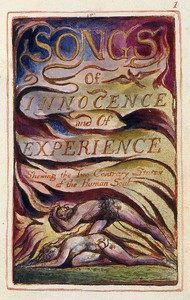

William Blake's 'Songs of Innocence and of Experience' illuminates the duality of the human condition through the lens of childhood innocence and adult experience
Read full overviewShow less›
In 'Songs of Innocence and of Experience,' William Blake explores the contrasting states of the human soul, illustrating how innocence and experience shape our perceptions of the world. Through a series of poignant poems, Blake invites readers into a realm where the purity of childhood meets the harsh realities of adult life. The work is a profound meditation on the nature of existence, spirituality, and the loss of innocence, crafted with vivid imagery and lyrical beauty. Readers will discover how Blake's dual vision serves as a commentary on society, religion, and the complexities of human emotion, ultimately encouraging a deeper reflection on their own life experiences.
William Blake's 'Songs of Innocence and of Experience' offers a profound exploration of the dualities that characterize the human experience. By juxtaposing the innocence of childhood with the complexities of adulthood, Blake invites readers to reflect on their own journeys and the interplay of joy and sorrow within their lives. The work serves as a timeless reminder of the importance of nurturing our inner child, embracing imagination, and seeking a deeper understanding of ourselves and the world around us. Ultimately, Blake's poetry challenges us to recognize the beauty in both innocence and experience, advocating for a life that honors the richness of our shared human condition.
Ratings at a glance
- 1The Innocence of Childhood
- 2The Loss of Innocence
- 3Duality of Existence
- 4Spirituality and Divinity
- 5Social Critique and Commentary
Notable quotes
“‘Pipe a song about a Lamb!’ So I piped with merry cheer.”
“How sweet is the shepherd’s sweet lot!”
“The sun does arise, And make happy the skies;”
A glimpse inside

Blake's 'Songs of Innocence' captures the essence of childhood, portraying it as a time filled with joy, simplicity, and a deep connection to nature. Read moreBlake's 'Songs of Innocence' captures the essence of childhood, portraying it as a time filled with joy, simplicity, and a deep connection to nature. Poems such as 'The Lamb' and 'The Shepherd' emphasize the purity and vulnerability of children, who embody a natural and divine innocence. In 'The Lamb,' the speaker's gentle questioning to the lamb mirrors a child's curiosity about the world, illustrating a direct relationship with creation. The playful imagery of the lamb and the shepherd reflects a harmonious relationship with the world, where joy and peace reign. In 'The Shepherd,' the shepherd's watchful role symbolizes a protective presence, suggesting that innocence is safeguarded by love and care. This innocence is not merely a state of being; it is depicted as a sacred gift, a reflection of the divine that should be cherished and protected against the encroaching complexities of adulthood. Through these poems, Blake emphasizes that the innocence of childhood is a vital aspect of the human experience, offering a glimpse into the divine nature that exists within us all. Show less
As the collection transitions into 'Songs of Experience,' Blake reveals the darker realities that accompany the loss of innocence. Read moreAs the collection transitions into 'Songs of Experience,' Blake reveals the darker realities that accompany the loss of innocence. The poem 'The Garden of Love' stands as a powerful symbol of this transition, where the once vibrant garden of childhood is replaced by a chapel that imposes restrictions and rules. The closed gates and the inscription 'Thou shalt not' represent the societal constraints that inhibit freedom and joy. This shift underscores the idea that adulthood often brings with it a sense of disillusionment and despair, as the pure joys of childhood are overshadowed by the complexities and burdens of life. In 'The Little Black Boy,' the speaker's journey from innocence to a confrontation with racial identity reflects a broader experience of loss—where the enlightenment of innocence is clouded by societal prejudice. Blake poignantly illustrates how societal expectations can stifle the spirit, leading to a yearning for the lost simplicity of youth. Furthermore, the loss of innocence is portrayed not merely as a personal tragedy but as a societal failure that impacts the collective human experience, suggesting that the transition into adulthood can often feel like a loss of connection to both oneself and one's surroundings. Show less
Read the full text — free
About the author
Read William Blake's work free on Lumina — the complete text plus an 8-minute summary and key ideas, no account needed