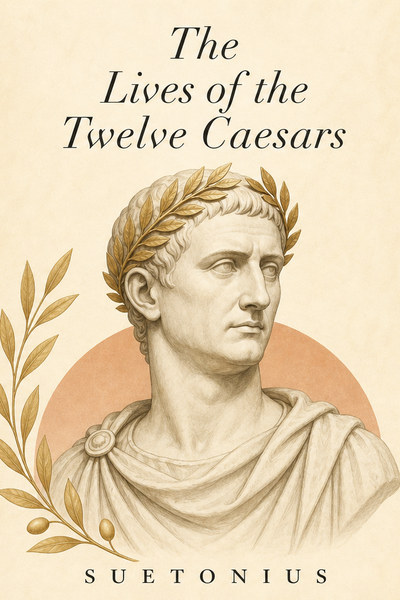

Suetonius's 'The Lives of the Twelve Caesars' unveils the tumultuous lives and characters of Rome's most powerful leaders, revealing how personal vices and virtues shaped an empire
Read full overviewShow less›
In 'The Lives of the Twelve Caesars', Suetonius offers readers a vivid and often scandalous portrait of the first twelve emperors of Rome, from Julius Caesar to Domitian. This work, more memoir than history, focuses on the personal habits, character traits, and anecdotes of each ruler, rather than military conquests or political machinations. Through engaging narratives, Suetonius explores how these figures wielded power and their impact on the Roman state, infusing their life stories with a mix of intrigue, drama, and moral lessons. Readers will gain insight into the complexities of leadership, the interplay between personal and political life, and the often stark realities of power in ancient Rome.
Suetonius's 'The Lives of the Twelve Caesars' provides a compelling exploration of the complexities of leadership and the human condition through the lens of Rome's most notable rulers. Each emperor's story reflects not only their personal triumphs and tragedies but also the broader themes of power, morality, and the consequences of ambition. The narratives serve as timeless lessons on the nature of authority and the delicate balance between personal character and public responsibility. In a world where the echoes of history continue to resonate, Suetonius's work remains a vital resource for understanding the interplay of individual virtues and vices in shaping the course of civilizations.
- 1Julius Caesar: The Conqueror with a Flawed Legacy
- 2Augustus: The Master of Propaganda
- 3Tiberius: The Reluctant Emperor
- 4Caligula: The Epitome of Excess
- 5Claudius: The Unlikely Emperor
Notable quotes
“Your suit is granted, and you may take him among you; but know... that this man, for whose safety you are so extremely anxious, will, some day or other, be the ruin of the party of the nobles.”
“I will never return home unless I am elected pontiff.”
“This was their intention: I, Caius Caesar, after all the great achievements I had performed, must have been condemned, had I not summoned the army to my aid!”
A glimpse inside

Julius Caesar, renowned for his military genius and political acumen, also faced deep personal challenges and controversies. Read moreJulius Caesar, renowned for his military genius and political acumen, also faced deep personal challenges and controversies. His early life was marked by significant loss, having lost his father at sixteen, which propelled him into a tumultuous political landscape. His defiance against dictator Sulla, refusing to divorce his wife Cornelia, demonstrated his commitment to personal loyalty over political safety, leading to his temporary exile. Caesar's military career began in Asia, but it was his subsequent campaigns in Gaul that solidified his legacy. His ambition often led him into conspiracies and scandals, including suspicions of sexual relationships with powerful figures like Nicomedes of Bithynia. Suetonius paints a picture of a man whose drive for conquest and glory was often complicated by his personal indiscretions and political machinations, culminating in his assassination—a direct result of his overwhelming ambition and the fears it instilled in others. Show less
Augustus, the first emperor of Rome, transformed the Republic into an empire with shrewd political strategies and a keen sense of public relations. Read moreAugustus, the first emperor of Rome, transformed the Republic into an empire with shrewd political strategies and a keen sense of public relations. He was adept at using propaganda, carefully crafting an image of himself as a restorer of the Republic while consolidating power in a manner that ensured his longevity. His reign saw the establishment of the Pax Romana, a period of relative peace that allowed for stability and prosperity across the empire. Augustus's personal life was equally complex; his marriage to Livia was marked by political maneuvering and potential scandal. His careful management of public perception, including the promotion of traditional Roman values and moral reforms, highlighted his understanding of the importance of public approval. Suetonius illustrates how Augustus's ability to balance personal ambition with the needs of the state set a precedent for future rulers, establishing a model of leadership that emphasized both authority and the façade of humility. Show less
Read the full text — free
About the author
Read Suetonius's work free on Lumina — the complete text plus an 8-minute summary and key ideas, no account needed