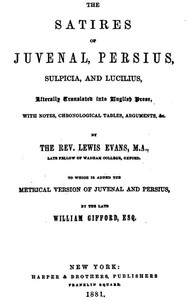
The Satires of Juvenal, Persius, Sulpicia, and Lucilius: Literally translated into English prose, with notes, chronological tables, arguments, &c. by Persius — Summary, Key Ideas & Full Text
739 pages28 chapters14h 50m read10h 32m speed read✦ 10-min Big ideasFree · no account
What is The Satires of Juvenal, Persius, Sulpicia, and Lucilius: Literally translated into English prose, with notes, chronological tables, arguments, &c. about?
The Satires of Juvenal and Persius: A profound exploration of moral decay in Roman society through sharp wit and biting social commentary
Read full overviewShow less›
This collection of satires, originally penned in the depths of Roman antiquity, serves as a timeless critique of societal vices that resonate even in contemporary discourse. Juvenal and Persius wield their pens with the precision of a sword, cutting through the facade of Roman life to expose the corruption, hypocrisy, and moral decay that plagued their society. Readers will delve into a rich tapestry of themes including avarice, luxury, and the pitfalls of human desires, all presented with a mix of humor and gravity. Through their sharp observations, the poets challenge us to reflect on our own moral compass and the societal values we uphold. This exploration is not merely historical; it invites us to confront the enduring human condition and the timeless struggle against vice and moral complacency.
The Satires of Juvenal and Persius provide a profound and unflinching examination of the moral landscape of Roman society, revealing the complexities of human nature and the societal values that shape behavior. Through their sharp wit and incisive commentary, the poets invite readers to reflect on their own lives and the ethical dilemmas they face. The themes of avarice, luxury, and moral complacency resonate powerfully, urging a reevaluation of contemporary values and priorities. As we engage with these timeless works, we are reminded of the ongoing struggle against vice and the importance of cultivating a society rooted in integrity and compassion. The lessons imparted by these ancient poets remain relevant, challenging us to confront our own complicity in societal decay and inspiring us to strive for a more virtuous world.
In the opening satire, the poets draw a parallel between a council of gods deliberating the fate of Rome and the moral crises faced by its citizens. Read moreIn the opening satire, the poets draw a parallel between a council of gods deliberating the fate of Rome and the moral crises faced by its citizens. This divine assembly, reminiscent of Homer's Odyssey, showcases Jupiter's absence as a metaphor for the neglect of true moral guidance. The council's discussion reveals that the greatest threats to Rome are not external enemies but rather the internal decay brought on by greed and corruption. The gods conclude that drastic measures, including the elimination of certain individuals, are necessary to salvage the state. This satirical framework underscores the absurdity of relying on divine intervention when the root of the problem lies within the hearts of individuals, prompting readers to consider their own complicity in societal decay. The satire serves as a sharp reminder that societal renewal must begin with individual moral reckoning and action. Show less
Luxury and Its Destructive Power
Juvenal and Persius vividly depict luxury as a corrosive force that undermines the very fabric of Roman society. They illustrate how the pursuit of opulence leads to mora… Read moreJuvenal and Persius vividly depict luxury as a corrosive force that undermines the very fabric of Roman society. They illustrate how the pursuit of opulence leads to moral degradation and societal collapse. The poets argue that luxury breeds vice, encouraging avarice and indulgence while eroding virtues such as frugality and integrity. Through sardonic examples, they highlight the absurdity of excess, such as the extravagant feasts consumed by the elite while the common people suffer. The image of gluttony is juxtaposed with the plight of the poor, creating a stark contrast that emphasizes the moral bankruptcy of those who indulge without concern for others. This critique resonates with modern audiences, as it prompts a reflection on contemporary consumerism and the ways in which it may compromise moral values and social responsibility. The poets call for a return to simplicity and virtue, positioning luxury as a primary adversary in the quest for a just society. Show less
Yes — the complete text of The Satires of Juvenal, Persius, Sulpicia, and Lucilius: Literally translated into English prose, with notes, chronological tables, arguments, &c. is free to read online, with no account and no ads. The 8-minute Big-ideas summary and audio narration are unlocked too