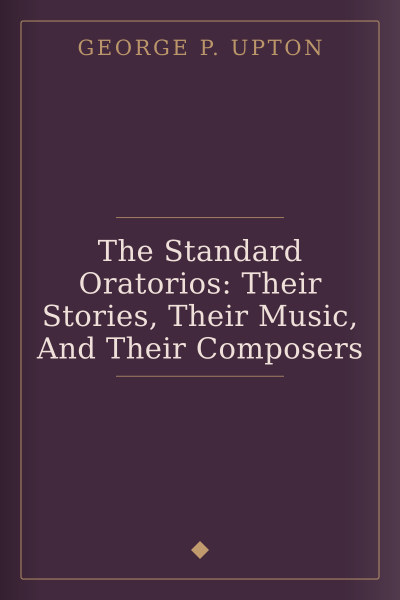

Uncover the profound narratives, music, and composers behind the world's greatest oratorios
Read full overviewShow less›
The 'Standard Oratorios' serves as an essential guide to understanding the rich tapestry of sacred music that has shaped the oratorio genre. It explores the compelling stories behind famous works, detailing the compositions that have become cornerstones of classical music. Each oratorio is presented with a historical context, insights into its musical structure, and a glimpse into the lives of the composers who brought these masterpieces to life. With a focus on accessibility, the book offers a treasure trove of information for both casual listeners and serious music enthusiasts. By delving into these sacred narratives, readers will gain a deeper appreciation for the emotional and spiritual power of oratorio music.
The 'Standard Oratorios' offers an enlightening exploration of the sacred music that has shaped the oratorio genre, revealing the profound narratives and emotional depths embedded within these works. By examining the stories, composers, and historical contexts, readers gain a richer understanding of how music can articulate the complexities of the human experience. The book underscores the oratorio's enduring relevance, demonstrating its capacity to connect listeners with timeless themes of faith, suffering, and redemption. Ultimately, this exploration invites both casual listeners and dedicated music lovers to appreciate the transformative power of the oratorio and its role in the broader landscape of classical music.
- 1The Evolution of the Oratorio
- 2Handel's 'Israel in Egypt': A Choral Masterpiece
- 3Bach's Sacred Narratives: 'Christmas Oratorio' and 'St. Matthew Passion'
- 4Beethoven's Unique Contributions: 'The Mount of Olives'
- 5The Richness of Brahms' 'German Requiem'
A glimpse inside

The oratorio has undergone significant transformation since its inception, evolving through three principal stages: early Italian forms, the English oratorio, and the mor… Read moreThe oratorio has undergone significant transformation since its inception, evolving through three principal stages: early Italian forms, the English oratorio, and the more expansive German interpretations. Initially, oratorios were simple narratives set to music, often performed in church settings, where they served as a means of religious instruction. Over time, they incorporated dramatic elements and a wider range of musical styles, influenced by opera and symphonic music. The evolution of the oratorio reflects the changing cultural and musical landscapes of Europe, showcasing its adaptability and its ability to convey profound religious themes through increasingly complex musical structures. The book emphasizes this historical trajectory, illustrating how composers like Handel and Haydn contributed to the oratorio's rich tradition, laying the groundwork for future generations to explore and innovate within the genre. Show less
Handel's 'Israel in Egypt' stands out as a monumental choral work, characterized by its powerful double choruses and dramatic narrative. Read moreHandel's 'Israel in Egypt' stands out as a monumental choral work, characterized by its powerful double choruses and dramatic narrative. The oratorio opens with the Israelites' lamentation under Egyptian oppression, followed by a series of vivid musical representations of the plagues. Each section is meticulously crafted, showcasing Handel's ability to evoke emotion and imagery through music. The first part introduces the audience to the suffering of the Israelites with haunting choruses, while the climactic moments depicting the plagues employ intricate counterpoint to heighten the drama. Unlike Handel's other oratorios, there is no overture, immediately immersing the listener in the narrative. The work culminates in a jubilant celebration of liberation with the triumphant Song of Moses. Through detailed descriptions of the choruses and arias, the book emphasizes how 'Israel in Egypt' exemplifies the power of choral music to convey collective human experiences and emotions, making it a timeless piece in the choral repertoire. Show less
Read the full text — free
About the author
Read George P. Upton's work free on Lumina — the complete text plus an 8-minute summary and key ideas, no account needed