
Hugo Award Winner · Human-alien encounters · Imaginary wars and battles
The Three-Body Problem by 刘慈欣, Vincent Schmitt, Gwennaël Gaffric, Marc Simonetti — Summary, Key Ideas & Quotes
2008417 pages✦ 3-min Big ideas★ 3.9 (216)
Rate it
Cixin Liu's trilogy-opening novel about first contact with aliens and the clandestine struggle with them over Earth's future, and its scientific progress in particular. Set against the backdrop of China's Cultural Revolution, a secret military project sends signals into space in an attempt to make contact with aliens—and they succeed. An alien civilization on the brink of destruction captures the signal and plans to invade Earth. Now, on Earth, different factions start forming, planning to either welcome the superior beings and help them take over a world seen as corrupt, or fight against the invasion. The result is a science fiction masterpiece of enormous scope and vision.
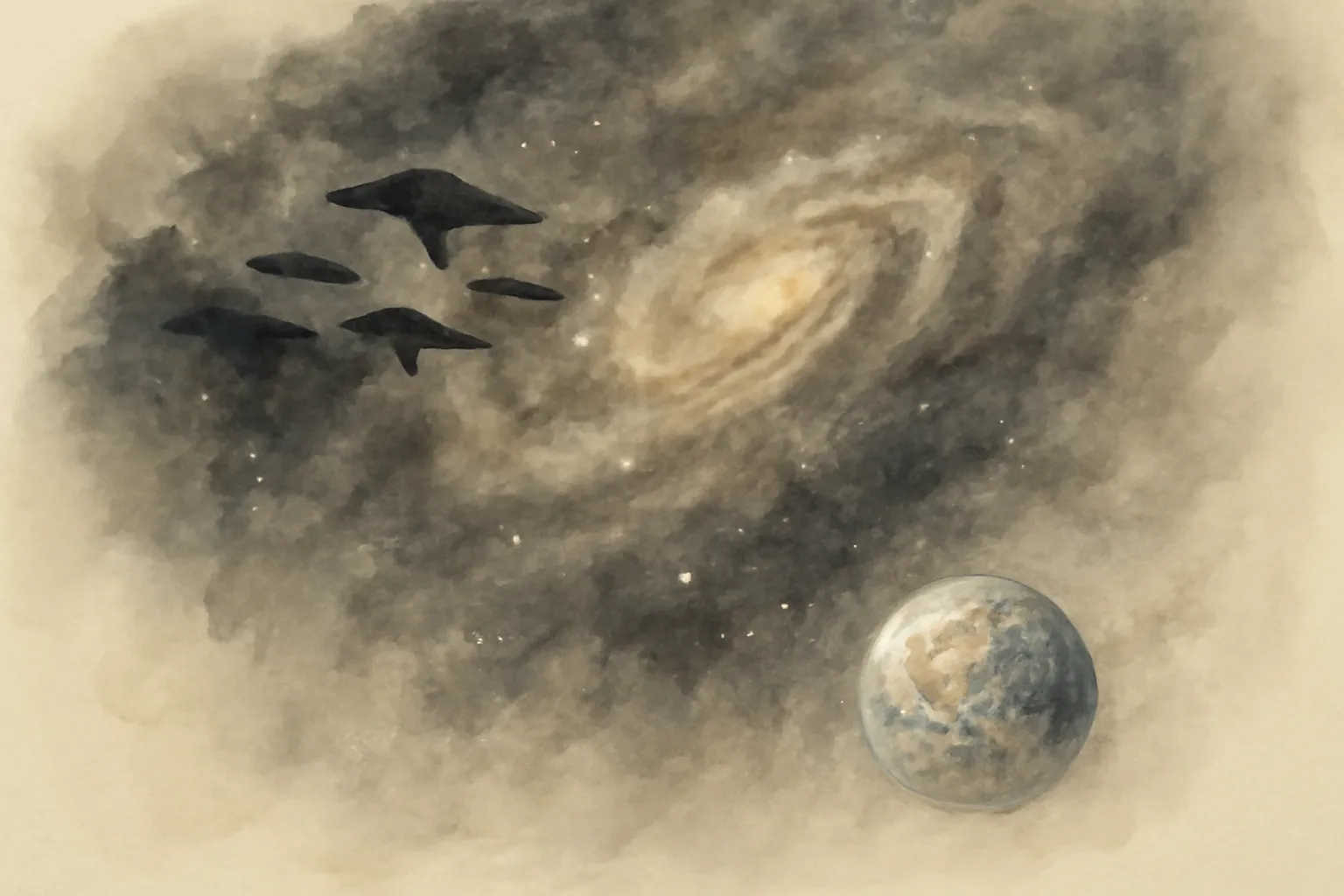
Unlike many first contact stories that imagine communication or cooperation, The Three-Body Problem posits that contact with an advanced alien civilization is inherently dangerous. The Trisolarans, facing extinction, see Earth as a potential new home, setting up a scenario where humanity’s survival is at stake. The novel explores the Fermi Paradox and the 'dark forest' hypothesis, suggesting that civilizations may remain silent out of fear. This reframes first contact not as a hopeful moment, but as a trigger for existential dread and profound uncertainty.
A central theme is the vulnerability of scientific progress. The Trisolarans sabotage human science, causing inexplicable phenomena and halting advances in physics. This creates a sense of helplessness and forces characters to question the reliability of their knowledge. The novel examines how scientific stagnation can paralyze societies, and how the pursuit of truth is both a strength and a weakness when facing the unknown.
“In the face of madness, rationality was powerless.”
“Weakness and ignorance are not barriers to survival, but arrogance is.”