
Correspondence · Autobiography · American Novelists
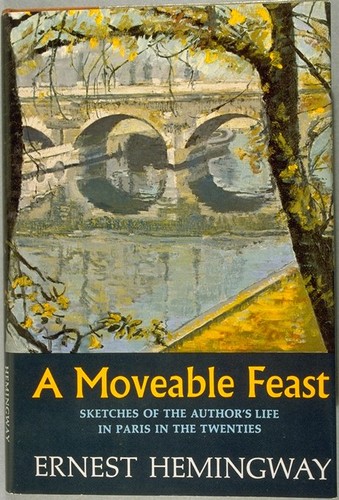
A Moveable Feast by Ernest Hemingway — Summary, Key Ideas & Quotes
1964209 pages✦ 3-min Big ideas★ 4.0 (4)
Rate it
A Moveable Feast is a 1964 memoir belles-lettres by American author Ernest Hemingway about his years as a struggling expat journalist and writer in Paris during the 1920s. It was published posthumously.[1] The book details Hemingway's first marriage to Hadley Richardson and his associations with other cultural figures of the Lost Generation in Interwar France. The memoir consists of various personal accounts by Hemingway and involves many notable figures of the time, such as Sylvia Beach, Hilaire Belloc, Bror von Blixen-Finecke, Aleister Crowley, John Dos Passos, F. Scott and Zelda Fitzgerald, Ford Madox Ford, James Joyce, Wyndham Lewis, Pascin, Ezra Pound, Evan Shipman, Gertrude Stein, Alice B. Toklas, and Hermann von Wedderkop. The work also references the addresses of specific locations such as bars, cafes, and hotels, many of which can still be found in Paris today. Ernest Hemingway's suicide in July 1961 delayed the publication of the book due to copyright issues and several edits which were made to the final draft. The memoir was published posthumously in 1964, three years after Hemingway's death, by his fourth wife and widow, Mary Hemingway, based upon his original manuscripts and notes. An edition altered and revised by his grandson, Seán Hemingway, was published in 2009.
Hemingway’s Paris is more than a setting—it’s a character in itself. The city, with its cafés, markets, and rain-swept streets, becomes a crucible for creativity and self-discovery. Hemingway captures the intoxicating blend of poverty and possibility that shaped his early work, suggesting that place can deeply influence artistic identity. Paris is depicted as both real and idealized, a city that lives on in memory and art, and that, once experienced, becomes 'a moveable feast' that stays with you forever.
The memoir offers vivid portraits of fellow expatriate artists—F. Scott Fitzgerald, Gertrude Stein, Ezra Pound, and others—whose friendships, rivalries, and eccentricities defined the era. Hemingway explores the camaraderie and competition among these writers, showing how their interactions fueled creativity but also bred insecurity and jealousy. The book captures the sense of a generation searching for meaning after World War I, united by artistic ambition and existential uncertainty.
“If you are lucky enough to have lived in Paris as a young man, then wherever you go for the rest of your life, it stays with you, for Paris is a moveable feast.”
“There is never any ending to Paris and the memory of each person who has lived in it differs from that of any other.”
“Hunger was good discipline.”
“We ate well and cheaply and drank well and cheaply and slept well and warm together and loved each other.”
