
The clearest possible introduction to the great questions — knowledge, matter, truth, and the limits of reason — by one of the twentieth century’s sharpest minds.
Read full overviewShow less›
In 'The Problems of Philosophy,' Bertrand Russell embarks on a journey through fundamental philosophical questions, challenging readers to scrutinize their assumptions about reality, knowledge, and existence. Russell's exploration reveals the intricate relationship between our perceptions and the world around us, prompting us to question the very nature of matter and the validity of our beliefs. By dissecting concepts like induction, truth, and universals, he equips readers with the tools to navigate the murky waters of philosophical inquiry. This book not only aims to clarify philosophical problems but also emphasizes the importance of critical thinking in understanding our place in the universe. Ultimately, Russell advocates for the study of philosophy as a means to enrich the mind and confront life's profound mysteries.
Russell's 'The Problems of Philosophy' navigates the intricate landscape of philosophical inquiry, illuminating the complexities of knowledge, existence, and reality. Through rigorous examination of concepts such as induction, idealism, and universals, he encourages readers to engage critically with their beliefs and the assumptions that underpin them. The book serves as a reminder of the value of philosophy in fostering intellectual growth and addressing the profound mysteries of life. By challenging us to question the nature of our reality and the validity of our knowledge, Russell not only enriches our understanding but also underscores the importance of philosophical inquiry in navigating the complexities of existence. Ultimately, this exploration invites readers to embrace the uncertainties of life as opportunities for deeper understanding and reflection.
- 1Appearance vs. Reality
- 2The Existence of Matter
- 3The Nature of Matter
- 4Understanding Idealism
- 5Knowledge by Acquaintance vs. Knowledge by Description
Notable quotes
“Is there any knowledge in the world which is so certain that no reasonable man could doubt it?”
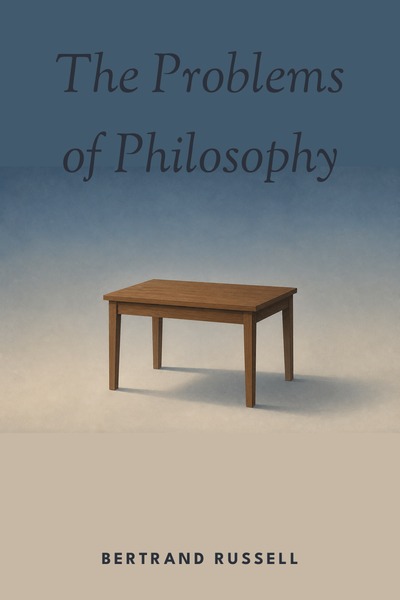
“To the eye it is oblong, brown and shiny, to the touch it is smooth and cool and hard.”
“The question we have to consider in this chapter is: What is the nature of this real table, which persists independently of my perception of it?”

A glimpse inside

Russell opens with a fundamental question: Is there any knowledge so certain that no reasonable person could doubt it? This question highlights the philosophical endeavor… Read moreRussell opens with a fundamental question: Is there any knowledge so certain that no reasonable person could doubt it? This question highlights the philosophical endeavor to critically examine beliefs rather than accept them dogmatically. In everyday life, we often take for granted our perceptions of reality, such as the existence of objects we see and touch. However, upon closer inspection, these perceptions can reveal contradictions and uncertainties. For example, when observing a table, one might note its color, shape, and texture, yet all these qualities depend on subjective experience. This leads to the realization that our immediate experiences, while seemingly certain, require rigorous philosophical inquiry to ascertain their truth. Russell asserts that engaging with these uncertainties is the essence of philosophy, which seeks to clarify and address the vagueness inherent in our ordinary ideas. Show less
The question of whether matter exists independently of our perceptions is pivotal in philosophy. Russell challenges readers to consider if objects like tables exist outsi… Read moreThe question of whether matter exists independently of our perceptions is pivotal in philosophy. Russell challenges readers to consider if objects like tables exist outside of our minds or if they are merely constructs of imagination. This exploration is crucial because, if we doubt the existence of physical objects, we also cast doubt on the existence of other minds, leading to a potentially isolating conclusion that we may be the only conscious beings. While this idea cannot be definitively disproven, Russell argues there is insufficient reason to accept it as true. He emphasizes that while we can doubt the physical existence of objects, we cannot doubt the sense-data that informs our perceptions. Thus, even though our interpretations of the external world may be flawed, the sensations we experience are undeniable, providing a foundation from which to explore the nature of reality. Show less
Read the full text — free
About the author
Read Bertrand Russell's work free on Lumina — the complete text plus an 8-minute summary and key ideas, no account needed.
Frequently asked
Worlds to get lost in
Take Lumina everywhere
Read offline, listen to AI summaries, speed-read, and sync your progress across devices — free on iPhone.
Download for iPhone