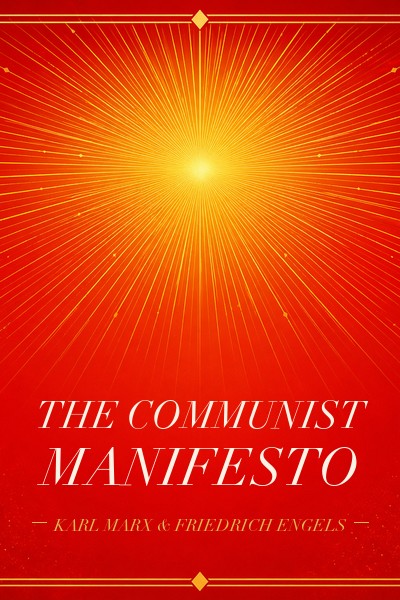

A foundational political pamphlet — class struggle, capitalism, and a call to revolution.
Read full overviewShow less›
In a world marked by stark social divisions, 'The Communist Manifesto' stands as a powerful critique of capitalism and class struggle. Karl Marx and Friedrich Engels articulate the historical context of societal changes, emphasizing how class antagonisms have shaped human history. This manifesto serves not only as a call to arms for the working class but also as a profound examination of economic systems that perpetuate inequality. Readers will gain insights into the dynamics of class relations, the role of the proletariat in overthrowing the bourgeoisie, and the implications of communism as a transformative political ideology. As the authors dissect the evolution of society, they provide a framework for understanding contemporary issues surrounding labor, capitalism, and social justice.
The enduring relevance of 'The Communist Manifesto' lies in its incisive analysis of class struggle and its call for revolutionary action. Marx and Engels provide a framework for understanding the dynamics of power, exploitation, and resistance that continue to shape our world. By emphasizing the need for solidarity among the working class, they inspire a vision of a future free from the constraints of capitalism. The manifesto challenges us to consider our roles in the ongoing struggle for justice and equality, urging us to recognize the interconnectedness of our struggles across borders. As we grapple with contemporary issues of inequality and oppression, the insights of 'The Communist Manifesto' remain a powerful reminder of the potential for change through collective action.
- 1The Essence of Class Struggle
- 2The Rise of the Bourgeoisie
- 3The Proletariat's Role in Revolution
- 4Communism vs. Bourgeois Property
- 5The Reactionary Nature of Feudal Socialism
A glimpse inside

At the heart of 'The Communist Manifesto' is the assertion that history is fundamentally the story of class struggles. Marx and Engels argue that every society has been b… Read moreAt the heart of 'The Communist Manifesto' is the assertion that history is fundamentally the story of class struggles. Marx and Engels argue that every society has been built upon the conflict between the oppressors and the oppressed. From the ancient Romans with their slaves to the feudal lords and serfs, these opposing forces have engaged in constant battles that either led to societal revolutions or mutual destruction. The modern era, characterized by the rise of the bourgeoisie, simplifies these conflicts into two primary classes: the bourgeoisie, who own the means of production, and the proletariat, who sell their labor. This reduction of class antagonisms highlights the urgency of the proletariat's struggle against bourgeois supremacy, setting the stage for revolutionary change. Show less
The emergence of the bourgeoisie is intricately linked to the collapse of feudal society. Marx and Engels illustrate how the discovery of new trade routes and markets fue… Read moreThe emergence of the bourgeoisie is intricately linked to the collapse of feudal society. Marx and Engels illustrate how the discovery of new trade routes and markets fueled the growth of the bourgeois class, which began as chartered burghers in medieval towns. The transition from feudalism to capitalism was marked by significant economic changes, such as the shift from guild monopolies to manufacturing systems that embraced division of labor. This new class not only transformed the economy but also redefined social relations, establishing a society that, while more simplified in terms of class structure, perpetuated exploitation. The authors argue that the bourgeoisie is both a product of historical development and a force that continues to shape societal dynamics, creating conditions ripe for revolution. Show less
Read the full text — free
About the author
Read Karl Marx and Friedrich Engels's work free on Lumina — the complete text plus an 8-minute summary and key ideas, no account needed.
Frequently asked
Worlds to get lost in
Take Lumina everywhere
Read offline, listen to AI summaries, speed-read, and sync your progress across devices — free on iPhone.
Download for iPhone